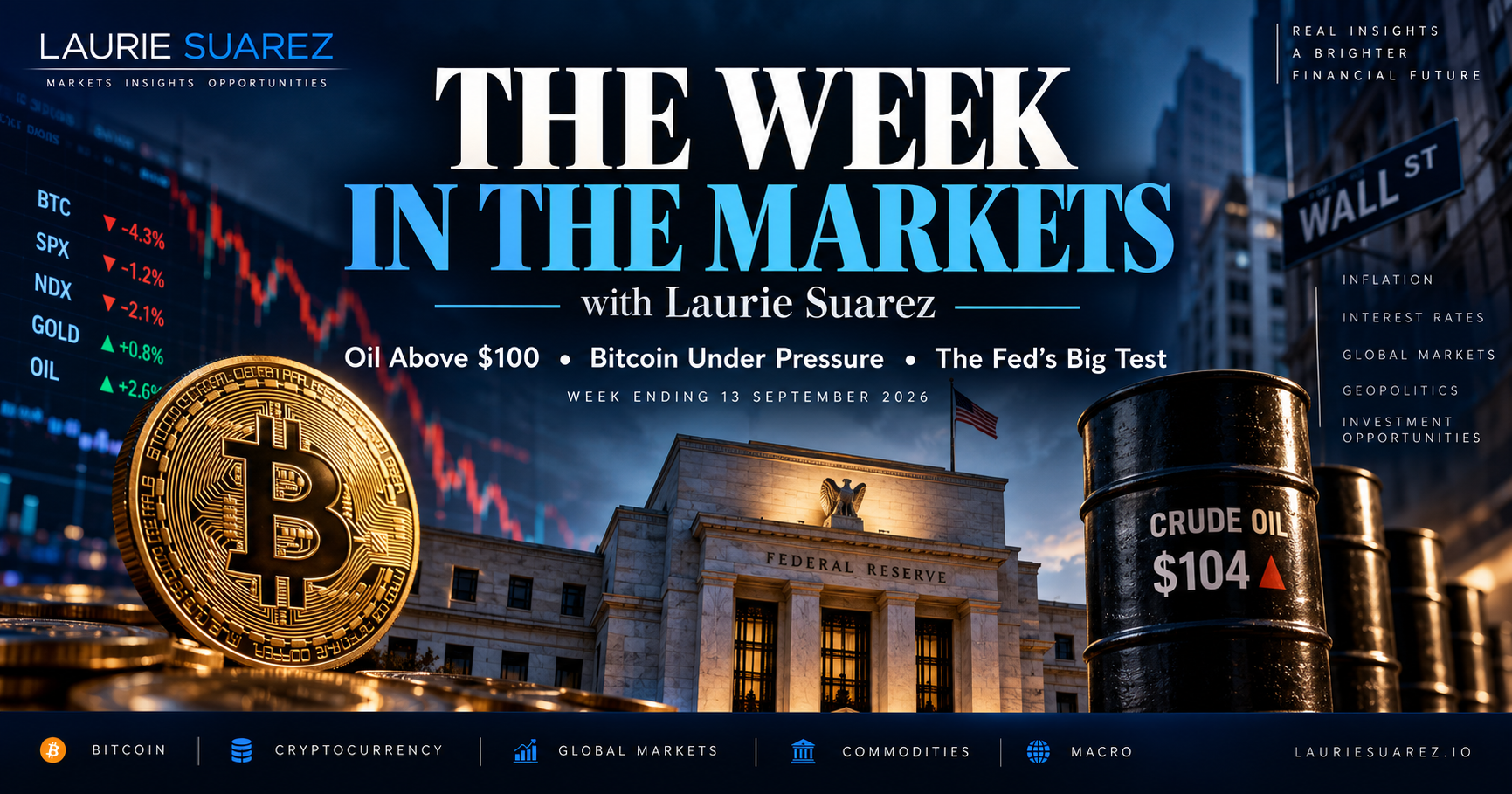
Global financial markets have entered what may prove to be one of the most consequential weeks of 2026.
Oil prices have surged above $100 per barrel, driven by supply concerns that show no sign of abating. Bitcoin is testing critical technical support levels around $76,000, with institutional outflows adding to the pressure. U.S. Treasury yields are hovering just below 5% — a level that, if breached, could reshape the pricing of risk assets across the board.
And at the centre of it all, the Federal Reserve will meet on September 15–16 to decide whether to raise interest rates again.
The confluence of these forces — energy, inflation, monetary policy and risk-asset positioning — creates a market environment that demands careful analysis rather than reflexive reaction.
This edition of The Week in the Markets examines what happened last week, why it matters, and what investors should be watching in the days ahead.
The real market-moving event will be what the Fed says comes next.
Oil Has Become the Market's Wild Card
Oil has moved from a background variable to the single most disruptive force in global markets. Brent crude trading above $104 per barrel is not merely an energy story — it is a macro story with cascading implications.
The immediate driver is supply. Production disruptions and geopolitical tensions have constrained global supply at a time when seasonal demand typically peaks. But the deeper concern is what sustained elevated oil prices mean for inflation.
When oil prices rise, the effects propagate through the economy with a lag. Transportation costs increase. Manufacturing inputs become more expensive. Consumer energy bills rise. Each of these channels feeds back into the inflation data that central banks watch most closely.
The Federal Reserve has been clear that it views inflation as the primary risk. If oil remains above $100 for an extended period, the already-elevated inflation readings of 3.4% could prove sticky — or even accelerate. That would put the Fed in an extraordinarily difficult position.
For Bitcoin and crypto, the oil-inflation-Fed transmission chain is critical. Higher oil leads to higher inflation expectations. Higher inflation expectations lead to tighter monetary policy expectations. Tighter monetary policy expectations lead to higher Treasury yields. Higher Treasury yields lead to pressure on risk assets, including Bitcoin.
This is why oil — an asset that Bitcoin investors once paid little attention to — has become one of the most important variables to watch.
The key question for the week ahead is whether oil stabilises near current levels or pushes higher toward $110–$120. The answer will shape the Fed's calculus and, by extension, the direction of every major asset class.
Bond Yields Are Sending a Warning
The U.S. 10-year Treasury yield sits at approximately 4.99% — tantalisingly close to the psychologically critical 5% level.
This is not merely a number on a screen. The 10-year yield is the benchmark for pricing risk across the entire financial system. When it rises, the discount rate applied to future cash flows increases. Assets whose value depends on future growth — technology stocks, growth equities, and increasingly Bitcoin — feel the pressure.
A sustained move above 5% would be significant for several reasons.
First, it would signal that bond markets are pricing in a higher-for-longer interest rate scenario. The Fed may pause, but if the bond market believes inflation will force further tightening, yields will rise regardless of what the Fed does.
Second, 5% on the 10-year creates a genuine alternative to risk assets. For the first time in years, investors can earn a meaningful risk-free return. This creates an opportunity cost for holding volatile assets like Bitcoin.
Third, rising yields strengthen the dollar. A stronger dollar puts downward pressure on Bitcoin, which is priced in dollars.
The bond market is often described as the smartest market in the world. If Treasury yields are signalling that the era of cheap money is truly over, risk assets will need to adjust to a fundamentally different pricing environment.
Bitcoin Faces a Critical Technical Test
Bitcoin enters the week trading near $77,000, having declined steadily over the past two weeks as macro headwinds have intensified.
The technical picture is straightforward. Bitcoin is approaching a critical support zone around $76,270. This level has held on two previous tests and represents the lower boundary of the current trading range. A decisive break below this level would target the $72,000–$74,000 zone, where larger stop-loss orders are likely clustered.
On the upside, resistance is layered. The first resistance sits at $81,700 — the recent breakdown level that now acts as overhead supply. Above that, the $83,000 level marks the top of the previous range.
The fundamental picture adds context to the technical setup. Spot Bitcoin ETFs saw outflows for a second consecutive week, suggesting that institutional buyers are de-risking ahead of the Fed meeting. Funding rates in the perpetual futures market have turned negative, indicating that leveraged traders are positioned for further downside.
However, there are constructive signals beneath the surface. Long-term holders — wallets that have held Bitcoin for more than 155 days — continue to accumulate. On-chain data shows that coins are moving from weak hands to strong hands, a pattern that has historically preceded recoveries.
The key issue is timing. In the immediate term, Bitcoin is hostage to the Fed. A dovish surprise could trigger a sharp short-covering rally. A hawkish outcome could break support and accelerate the decline.
For now, the most prudent approach is to watch the $76,270 level closely. How Bitcoin behaves at this level — and crucially, how it reacts to the Fed decision — will set the tone for the coming weeks.
Crypto Is Becoming Increasingly Sensitive to Macro Conditions
The relationship between cryptocurrency and the broader macroeconomic environment has shifted fundamentally over the past two years.
In the early years of Bitcoin, the narrative was one of independence — a digital asset uncorrelated to traditional markets, governed by its own supply schedule and adoption curve. That narrative was always somewhat overstated, but it contained a kernel of truth: crypto was small enough that its internal dynamics mattered more than external forces.
That is no longer the case. Bitcoin's correlation with the Nasdaq has strengthened significantly since 2022. Institutional participation through ETFs has tied Bitcoin more closely to the flows that drive equity markets. And the dominance of macro narratives — inflation, interest rates, the dollar — in shaping crypto prices is now undeniable.
The transmission mechanism works through several channels.
Inflation expectations drive Fed policy expectations. Fed policy expectations drive Treasury yields. Treasury yields drive the dollar and the pricing of risk assets. And the pricing of risk assets now includes Bitcoin and the broader crypto market.
This means that analysing Bitcoin in isolation — looking only at on-chain metrics, technical levels and crypto-specific narratives — is no longer sufficient. You cannot properly analyse Bitcoin anymore without analysing the global macro environment around it.
For crypto investors, this has practical implications. The Fed calendar matters. CPI prints matter. Treasury auction results matter. Oil prices matter. None of these were on the radar of most crypto investors five years ago. Today, they are among the most important variables.
The crypto market is growing up. It is becoming part of the global financial system. That brings legitimacy and capital — but it also means crypto is no longer immune to the forces that move every other market.
Wall Street: Resilient, But Not Immune
U.S. equities have shown remarkable resilience in the face of rising yields and oil shocks. The S&P 500 and Nasdaq have traded in relatively narrow ranges, suggesting that equity investors are not yet pricing in a severe downturn.
This resilience can be explained by several factors.
Corporate earnings have held up better than expected. Profit margins, while compressed, remain above historical averages. The labour market, though softening, has not deteriorated sharply. And the expectation that the Fed will cut rates in 2027 — even if it raises them this week — provides a forward-looking support for valuations.
However, the risks are building. If the 10-year yield moves decisively above 5%, the discount rate pressure on equities will intensify. Technology stocks, which are the most sensitive to interest rate changes, would be particularly vulnerable.
The financial sector is a wildcard. Banks benefit from higher interest rates on their lending, but rising yields also increase the risk of mark-to-market losses on their bond portfolios — the same dynamic that triggered the regional banking crisis of 2023.
For now, Wall Street is betting on a soft landing. If the Fed delivers a hawkish surprise this week, that bet could unwind quickly.
Gold's Strange Position
Gold is in an unusual position. The same forces that are pressuring Bitcoin — higher yields, a stronger dollar, tightening monetary policy — should, in theory, pressure gold as well. And to some extent they have.
But gold has been surprisingly resilient, trading near $4,350 per ounce. This resilience reflects the dual nature of gold as both a financial asset and a safe-haven store of value.
On one hand, gold competes with risk-free assets. When Treasury yields rise, the opportunity cost of holding gold increases. A 5% yield on a government bond is a meaningful alternative to a non-yielding asset.
On the other hand, gold benefits from exactly the kind of uncertainty that is currently dominating markets. Geopolitical risk, inflation uncertainty and the prospect of a policy mistake by the Federal Reserve all drive safe-haven demand.
The net effect is that gold is caught between two powerful but opposing forces. In a hawkish scenario — where the Fed raises rates and signals more tightening — gold could face significant downside. In a dovish scenario — where the Fed pauses or signals an end to tightening — gold could rally as the dollar weakens and real yields fall.
For the week ahead, gold is likely to be driven by the Fed outcome rather than by its own internal dynamics. It is, in effect, a bet on which way the Fed leans.
Federal Reserve Takes Centre Stage
The September 15–16 Federal Reserve meeting is the single most important event for global markets this week — and arguably this month.
Market pricing entering the week suggests an approximately 86% probability of a 25 basis point rate increase. This would bring the federal funds target range to 3.50%–3.75%.
But the rate decision itself is almost beside the point. What matters far more is the guidance that accompanies it.
Three things will be scrutinised in the Fed statement, the Summary of Economic Projections, and Chair Powell's press conference.
**The language.** Does the Fed characterise inflation as transitory or persistent? The word choice matters. If the Fed signals that it views the inflation uptick as temporary — driven by oil supply shocks rather than demand — it may justify a pause after this increase. If it characterises inflation as broadening, further tightening is on the table.
**The path.** The dot plot, which shows individual committee members' rate expectations, will be closely watched. Any upward shift in the 2027 median projection would signal that the Fed expects to hold rates higher for longer.
**Energy.** The Fed has historically been reluctant to react to oil price shocks, viewing them as supply-side phenomena outside its control. But if oil is feeding into core inflation — through transportation, services and wages — the Fed may be forced to acknowledge it as a persistent risk.
The market reaction will depend on the gap between expectations and reality. A 25bp increase is largely priced in. What is not priced in is a hawkish pivot — where the Fed raises rates and signals that more are coming because inflation remains unacceptably high.
If that happens, Treasury yields will surge, the dollar will strengthen, and risk assets across the board will face a significant repricing. Bitcoin, already under pressure, would likely test its support levels immediately.
Laurie's Forecast for the Week Ahead
My base case is continued elevated volatility. The market is correctly positioned for a 25bp increase, but the uncertainty around forward guidance is high. I expect significant price swings across all asset classes as the market processes the Fed's communication in real time.
Base Case
25bp rate increase with measured guidance. The Fed raises rates but signals that it is approaching the end of the tightening cycle. This would be the most balanced outcome — initially triggering volatility as the market digests the hike, followed by a focus on the forward guidance. Bitcoin support would be tested but likely hold. Risk appetite would return selectively as investors look past the hike to the eventual pause.
Dovish Surprise
Fed holds or provides materially softer guidance. The Fed surprises markets by pausing, citing concerns about economic growth or financial stability. Treasury yields would fall sharply, the dollar would weaken, and risk assets would rally. Bitcoin could see a rapid short-covering rally back toward the $81,000–$83,000 resistance zone.
Hawkish Shock
Rate increase accompanied by stronger tightening guidance. The Fed not only raises rates but signals that additional increases are likely if inflation does not cool. Treasury yields would surge above 5%, the dollar would strengthen significantly, and risk assets would face broad selling pressure. Bitcoin would likely break below $76,270 and target the $72,000–$74,000 zone.
The Bigger Picture
The past week demonstrates why investors need to look beyond individual asset prices.
Bitcoin's decline is not a Bitcoin story. It is a macro story. Oil prices are not an oil story. They are an inflation story. The Federal Reserve's decision is not a Fed story. It is a story about the entire pricing of risk in the global financial system.
Everything is connected. Energy prices feed into inflation. Inflation drives central bank policy. Central bank policy drives Treasury yields. Treasury yields drive the dollar and the pricing of risk assets. And risk assets — including Bitcoin — respond to all of it.
This is why The Week in the Markets takes a holistic approach. Analysing Bitcoin without analysing oil, Treasury yields, the dollar and the Federal Reserve is like analysing a single gear without understanding the machine it is part of.
The week ahead will provide important data points on all of these variables. But the most important question is not what the Fed does this week. It is what the Federal Reserve believes it must now do about inflation.
The answer could set the direction for global markets into the final quarter of 2026.